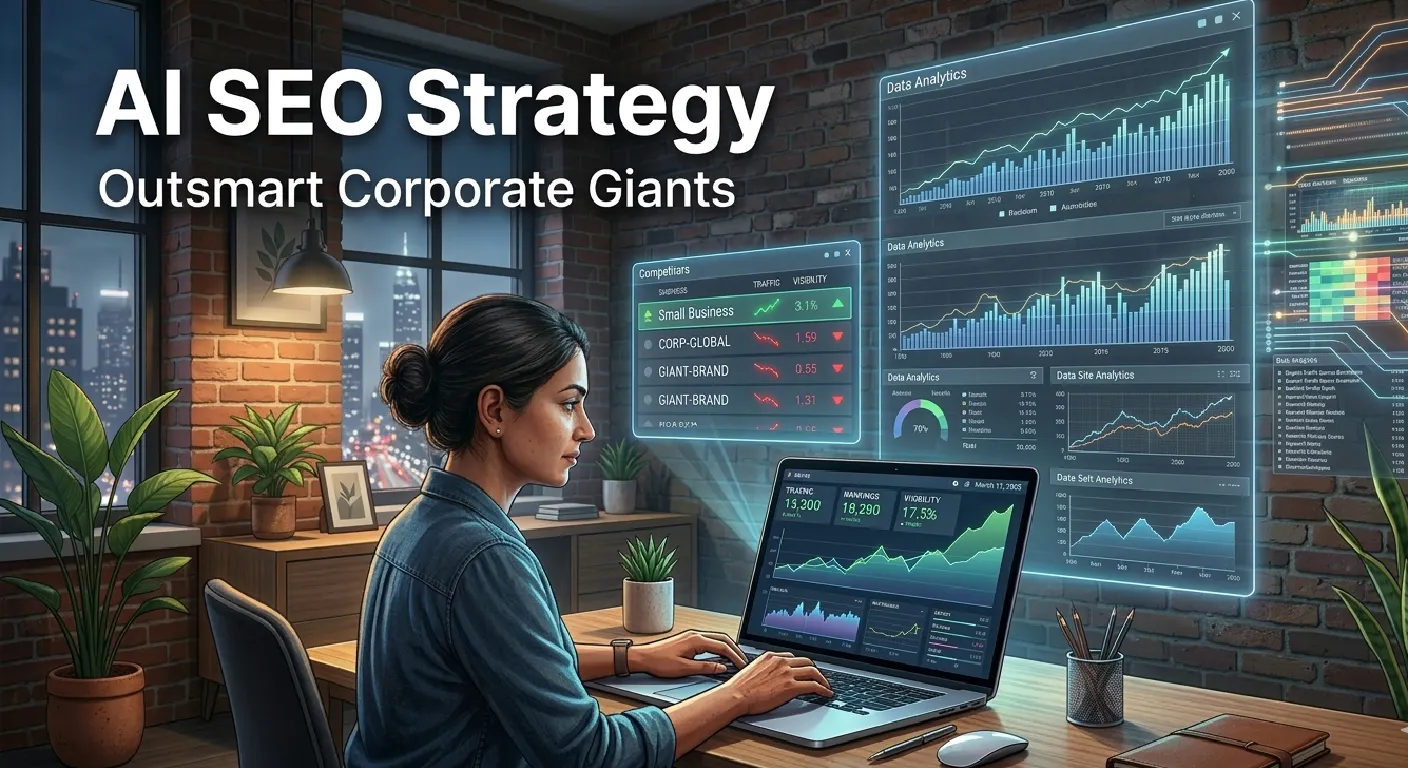
AI SEO Strategy for 2025: How Small Businesses Win
Introduction
For years, small businesses have been told the same thing about search engines: publish content, target the right keywords, build some backlinks, and eventually rankings will come.
But if you run a small business website, you already know that reality looks very different.
You might spend weeks writing blog posts, optimizing pages, and researching keywords—only to see giant companies dominate the first page of search results. Brands with massive marketing budgets, entire SEO teams, and thousands of backlinks often push smaller websites further down the rankings.
The frustrating part is that even when your content is genuinely helpful, it can still struggle to compete.
A local service company might publish a well-written article explaining a problem their customers face. Yet when someone searches for that exact problem, the results are often filled with large media websites, software companies, or global brands.
This situation has made many small business owners feel like organic search is becoming impossible to compete in.
But something significant has started to change.
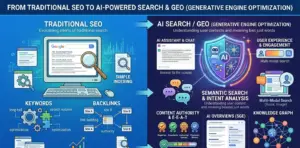
Search engines are evolving faster than ever before. Artificial intelligence is reshaping how search results are generated, how information is interpreted, and how websites are evaluated.
Instead of simply matching keywords, modern search systems analyze context, intent, topical authority, and usefulness.
That shift is exactly why strategies like AI SEO and Generative Engine Optimization are becoming so important.
Businesses that understand how AI-driven search works are no longer trying to compete the old way. They are building content ecosystems that search engines—and AI assistants—recognize as trusted sources of information.
This is where structured approaches like AI SEO Strategy start to make a real difference.
Instead of chasing rankings page by page, businesses focus on becoming the most reliable source on a topic.
And when that happens, even small companies can start appearing in search results alongside brands that once seemed impossible to compete with.
This guide will walk through exactly how that shift works, what has changed in modern search, and how small businesses can build an AI SEO strategy that allows them to compete with much larger competitors.
Why Traditional SEO Is No Longer Enough for Small Businesses
If you talk to most small business owners about SEO, the advice they’ve heard usually sounds something like this:
- Find keywords with good search volume
- Write blog posts around those keywords
- Add internal links
- Build backlinks
In theory, this approach still sounds logical.
But in practice, many small businesses are discovering that simply following these steps doesn’t guarantee visibility anymore.
Take a common situation.
Imagine a local interior design company that writes a detailed article explaining “how to design a small living room.” The article includes useful tips, images, and practical advice that real homeowners could follow.
Yet when someone searches that phrase, the first page is filled with results from global brands like lifestyle magazines, massive home décor websites, and large e-commerce companies.
The small business article—despite being helpful—often ends up buried on page three or four.
This isn’t because the content is bad.
It’s because search engines now evaluate websites based on topical authority, not just individual pages.
Large websites often rank higher because they have hundreds of related articles covering the same topic from multiple angles. From Google’s perspective, these sites appear to be stronger sources of knowledge.
This is one of the biggest reasons traditional SEO strategies struggle today.
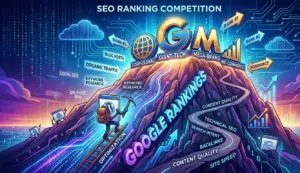
Publishing a single blog post on a topic is rarely enough anymore. Search engines expect to see a cluster of related content that demonstrates expertise across the entire subject.
Another major shift is the rise of AI-driven search results.
Search engines are increasingly generating direct answers, summaries, and AI-powered recommendations. Instead of simply listing webpages, they analyze content across the web and highlight sources that appear consistently reliable.
This means businesses that structure their content strategically have a much better chance of appearing in AI-generated answers.
This approach is closely connected to concepts like AI SEO Strategy and Generative Engine Optimization, where content is designed not just for traditional search rankings but also for AI systems that summarize and recommend information.
For example, a website that publishes multiple guides about interior design—covering small spaces, lighting, furniture layouts, and renovation planning—builds a stronger signal of expertise.
Search engines start recognizing that site as a reliable authority on interior design topics.
And when AI search systems generate answers related to those topics, that site is far more likely to be referenced.
This shift explains why many businesses are moving toward structured content strategies supported by Content Marketing Strategy Services that focus on building authority over time rather than chasing isolated keywords.
The key takeaway here is simple but powerful:
Modern SEO is no longer about ranking a single page.
It’s about building a topic ecosystem that search engines and AI systems recognize as trustworthy.
Small businesses that understand this shift can still compete—even against companies with much larger budgets.
But they need to approach SEO differently than they did just a few years ago.
How AI Is Changing Search Engines in 2025
Search engines are no longer just directories that list websites.

They are becoming intelligent systems that interpret information, summarize answers, and guide users directly to solutions.
If you have recently searched something on Google, you may have noticed that the search results page looks very different from what it did a few years ago.
Instead of only showing a list of websites, search engines now display AI-generated summaries, quick answers, and curated sources.
These changes are part of a larger shift toward AI-powered search experiences.
Google’s AI systems now analyze large amounts of information across the web and try to determine which sources provide the most useful answers to a question.
This means the goal of SEO is no longer just ranking for a keyword.
The real goal is becoming one of the sources that AI systems trust when generating answers.
For small businesses, this shift can actually create new opportunities.
In the past, competing with massive companies was extremely difficult because they had thousands of backlinks and huge marketing budgets.
But AI search systems evaluate more than just backlinks. They analyze how well a website explains a topic, how consistently it covers related questions, and whether users find the information helpful.
That means smaller websites that publish clear, structured, and genuinely useful content can still become trusted sources.
Consider a real-world example.
Imagine someone searches:
“how to improve website traffic for a small business.”
Instead of simply listing ten blue links, AI-powered search may generate a summary explaining the key steps.
But that summary has to come from somewhere.
Search engines look for websites that consistently publish reliable information about SEO, marketing strategies, and website growth.
Sites that build strong topical coverage around subjects like AI SEO Strategy, content optimization, and search visibility are far more likely to be referenced by these AI systems.
This is where the concept of Generative Engine Optimization becomes important.
Rather than focusing only on ranking individual pages, GEO focuses on creating content that AI systems can understand, reference, and recommend when answering user questions.
In simple terms, GEO prepares your website for a future where search engines behave more like intelligent assistants than traditional directories.
Another important trend is the rise of conversational search.
People are no longer typing short keyword phrases like:
“SEO tips small business”
Instead, they ask detailed questions such as:
“what is the best SEO strategy for a small local business with a limited budget?”
AI-driven search systems are designed to understand these longer, more natural questions.
This means businesses that publish detailed, informative content answering real questions have a better chance of appearing in these results.
Structured strategies like AI SEO Consulting Services help businesses identify the most important questions their audience is asking and build content that answers those questions clearly.
Over time, this approach creates a library of knowledge that search engines and AI assistants can rely on.
And when that happens, your website stops being just another page on the internet.
It becomes a trusted source of information.
The AI SEO Strategy That Actually Works for Small Businesses

Understanding how search engines are changing is important, but the real question every business owner asks is simple:
What should I actually do to get results?
The answer is not publishing random blog posts or chasing trending keywords.
The businesses that are seeing real growth from SEO today follow a structured system built around topic authority, helpful content, and strategic linking.
This approach is often called an AI SEO Strategy, and it focuses on helping search engines understand that your website is a reliable source on a specific subject.
Let’s break down what that actually looks like in practice.
1. Focus on Topics Instead of Individual Keywords
Traditional SEO strategies often revolve around finding individual keywords and writing articles around them.
For example:
- “small business SEO tips”
- “how to rank on Google”
- “increase website traffic”
While these keywords might bring traffic, writing isolated articles rarely builds long-term authority.
Modern SEO works better when businesses organize content around topic clusters.
Instead of writing one article about SEO, a website might publish multiple guides that answer different questions within the same subject.
For example:
- What is AI SEO and how does it work
- How AI search engines evaluate websites
- AI SEO strategy for small businesses
- Common SEO mistakes businesses make
- How to structure blog content for AI search
When these articles are internally connected, search engines start recognizing the website as an authority on SEO topics.
This is why structured blog ecosystems are a major part of AI SEO Strategy Services, where businesses build multiple related articles designed to strengthen each other.
Over time, this creates a powerful signal that your website is not just publishing random posts—it’s providing comprehensive knowledge.
2. Answer Real Questions Your Customers Are Asking
One of the biggest mistakes businesses make is writing content based only on keywords instead of real customer problems.
Think about the questions your customers actually ask.
A home renovation company might receive questions like:
- “How much does a kitchen renovation cost?”
- “How long does a home renovation take?”
- “What are the most common renovation mistakes?”
Each of these questions represents a valuable content opportunity.
When a business publishes clear answers to these questions, it creates content that is both useful for readers and highly relevant for search engines.
This type of question-driven content also performs well in AI search environments where systems try to provide direct answers to user queries.
Strategies like Content Strategy and SEO Consulting often begin by identifying the most common questions customers ask and turning those questions into structured articles.
This ensures that content is aligned with real user intent instead of guesswork.
3. Build Internal Linking That Guides Readers
Internal linking is one of the most overlooked aspects of SEO.
Many websites publish dozens of blog posts but fail to connect them in a meaningful way.
From a search engine’s perspective, these disconnected pages do not clearly demonstrate expertise.
But when articles are strategically linked together, they form a network of knowledge.
For example, a blog post about AI SEO strategy might link to related guides covering:
- AI search algorithms
- content optimization techniques
- common SEO mistakes
- future search trends
This creates a logical path for both readers and search engines.
Readers can explore topics in more depth, while search engines understand how different pieces of information relate to each other.
This is one reason why many businesses rely on Content Marketing Services that focus on building structured content ecosystems rather than isolated blog posts.
When done correctly, internal linking transforms a blog into a powerful knowledge hub.
4. Consistency Beats Volume
Another misconception about SEO is that businesses need to publish large amounts of content quickly.
In reality, consistency matters far more than volume.
Publishing one well-researched article every week can be far more effective than publishing ten low-quality posts in a short period.
Each article should focus on solving a specific problem and providing practical guidance.
Over time, these articles accumulate and create a valuable resource library.
Search engines reward websites that consistently publish helpful information because it signals reliability and ongoing expertise.
Businesses that follow this approach through structured AI SEO and GEO Optimization Services often see gradual but sustainable improvements in search visibility.
5. Treat Your Blog Like a Knowledge Platform
Many companies treat blogs as marketing tools.
But the most successful websites treat their blogs as knowledge platforms.
Instead of writing promotional content, they focus on publishing guides that genuinely help readers understand a topic.
For example:
A digital marketing agency could publish articles explaining:
- how SEO works
- how search engines rank websites
- how AI is changing digital marketing
- how businesses can build organic traffic
These educational resources build trust with readers.
And when people trust a website as a source of knowledge, they are far more likely to consider its services when they need professional help.
This approach aligns perfectly with the direction search engines are moving.
The websites that succeed in modern SEO are not just promoting services.
They are teaching, explaining, and guiding their audience.
And that is exactly what search engines want to recommend.
How Small Businesses Can Compete With Large Brands in Search
At first glance, competing with large companies in search results can feel impossible.
Big brands often have marketing teams, large advertising budgets, and entire departments dedicated to SEO. They publish huge amounts of content and earn thousands of backlinks from major websites.
For a small business owner managing marketing alongside daily operations, that level of competition can seem overwhelming.
But here’s something many people don’t realize.
Large companies often struggle with the same thing that small businesses are naturally good at:
focus.
Corporate websites typically try to target very broad audiences.
For example, a large home improvement brand might publish articles about hundreds of topics, including furniture, renovation, paint colors, flooring, kitchen appliances, and landscaping.
While this approach generates a lot of content, it also spreads their expertise across many different areas.
Small businesses can take advantage of this by focusing deeply on specific niches.
Let’s look at a practical example.
Imagine two websites competing in search results:
One is a massive lifestyle website that publishes general home improvement content.
The other is a small company that specializes specifically in small apartment interior design.
If the small business consistently publishes detailed guides about apartment layouts, furniture placement, storage solutions, lighting strategies, and renovation tips for compact spaces, something interesting starts to happen.
Over time, search engines begin recognizing that website as a specialized authority on small apartment design.
When someone searches for topics related to that niche, the smaller website can actually outrank larger competitors because its content demonstrates deeper expertise.
This is one of the core ideas behind AI SEO Strategy, where businesses focus on building authority around clearly defined topics instead of trying to compete everywhere.
Another advantage small businesses have is authentic experience.
Corporate websites often rely on generic content written at scale. While that content may be well optimized, it sometimes lacks real-world insights.
Small businesses, on the other hand, interact directly with customers every day.
A local interior designer knows the real challenges homeowners face when working with limited space. A digital marketing consultant understands the common mistakes small businesses make when trying to improve their online visibility.
When these real experiences are turned into educational content, the result is often far more valuable than generic articles written purely for SEO.
This type of practical, experience-based content performs extremely well when supported by structured Content Marketing Strategy Services, because it focuses on solving real problems rather than chasing traffic.
Another strategy that helps small businesses compete is answering long-tail search queries.
Large companies usually focus on high-volume keywords, but many search queries are much more specific.
For example:
- “best SEO strategy for a local service business”
- “how to get website traffic without ads”
- “AI SEO strategy for small business websites”
These types of searches may have lower volume individually, but they represent people who are actively looking for solutions.
By creating detailed articles that address these questions, smaller websites can capture highly targeted traffic that larger companies often overlook.
When this content is connected through a structured AI SEO Consulting Strategy, it builds a network of knowledge that strengthens the entire website.
Over time, this strategy allows small businesses to compete in areas where large companies cannot easily dominate.
The goal isn’t to beat corporate websites at everything.
The goal is to become the most trusted source within your niche.
And when that happens, search engines start treating your website differently.
Instead of being just another page competing for rankings, your site becomes a recognized authority within a specific subject area.
Building an AI SEO Strategy for the Future
Search is changing faster than it ever has before.
A few years ago, ranking on search engines was mostly about keywords, backlinks, and technical optimization. Businesses that followed those rules could steadily grow their visibility over time.
But the way people search for information today is evolving.
Search engines are becoming smarter, AI assistants are summarizing information directly for users, and people are asking longer, more conversational questions when they look for answers online.
These changes mean that businesses need to think about SEO differently than they did even five years ago.
Instead of focusing only on ranking pages, successful websites are now focused on becoming trusted sources of information.
This is where strategies like AI SEO Strategy and Generative Engine Optimization play an important role.
Rather than chasing short-term rankings, these approaches focus on building structured knowledge around topics that matter to your audience.
For example, a small business that wants to grow through organic search might begin by identifying the most common questions their customers ask.
From there, they can build a series of articles that answer those questions clearly and thoroughly.
Each article becomes part of a larger system of content that helps readers learn more about the topic.
Over time, this type of content library starts to signal expertise to search engines.
When search systems look for reliable sources of information, websites with consistent, helpful content are much more likely to be referenced.
Another important factor is user trust.
People are far more likely to engage with businesses that explain complex topics in simple, practical ways.
A website that teaches readers something valuable will always stand out compared to a website that simply tries to sell services.
This is why many companies are now investing in structured AI SEO and GEO Optimization Services that help them plan content ecosystems rather than isolated blog posts.
The goal is not just to attract visitors.
The goal is to build a website that becomes a resource people return to whenever they need answers.
And when that happens, growth becomes much more sustainable.
Small businesses may not always have the marketing budgets of large corporations.
But they can still compete by focusing on expertise, helpful content, and strategic topic coverage.
Search engines are constantly evolving to prioritize websites that genuinely help users.
Businesses that understand this shift early will have a significant advantage as AI-powered search continues to expand.
Turning Knowledge Into Growth
If there is one lesson to take away from the changes happening in search today, it’s this:
The future of SEO belongs to businesses that educate their audience.
Websites that consistently answer real questions, explain complex topics clearly, and provide genuine value will continue to gain visibility over time.
For many businesses, the challenge is not understanding the importance of SEO—it’s knowing how to build a strategy that actually works in a rapidly changing search environment.
That’s where a structured approach becomes valuable.
A well-planned AI SEO Strategy helps businesses identify the right topics, build authoritative content, and structure their website in a way that search engines and AI systems can easily understand.
When these elements work together, organic traffic becomes far more predictable and sustainable.
Businesses that want to stay competitive in the coming years should start thinking about how their website can become a trusted source within their industry.
The sooner that process begins, the stronger the long-term results tend to be.
FAQs
What is AI SEO and how can small businesses use it?
AI SEO is a modern search optimization approach that focuses on creating content search engines and AI systems can easily understand, analyze, and recommend. Instead of focusing only on keywords, AI SEO prioritizes helpful answers, topical authority, and structured content. Small businesses can use AI SEO Strategy to publish helpful blog content, answer customer questions, and build authority around specific topics in their industry.
Can small businesses really compete with big companies in Google search?
Yes, small businesses can compete by focusing on niche expertise instead of broad topics. Large companies often publish general content, while small businesses can create deeper, more practical guides within a specific subject area. When combined with a structured AI SEO Strategy, this focused content helps search engines recognize the website as a trusted authority.
How long does SEO take to work for a small business website?
Most small businesses begin seeing early improvements within 3 to 6 months after consistently publishing helpful content and optimizing their website. Strong results usually appear within 6 to 12 months as the site builds topical authority and earns trust from search engines through strategies like Generative Engine Optimization.
Why are blogs important for SEO and website traffic?
Blogs help businesses answer the questions potential customers are already searching for online. When blog posts are connected to service pages and other related articles, they create a content ecosystem that search engines understand. This approach helps businesses increase organic traffic and build trust with visitors through structured Content Marketing Strategy Services.
What type of content ranks best in AI-powered search results?
Content that answers real user questions clearly and provides practical insights tends to perform best in AI search results. AI systems prioritize websites that demonstrate expertise through detailed guides, structured explanations, and consistent topic coverage. Businesses that implement AI SEO and GEO Optimization Services often structure their content to make it easier for AI systems to reference.
What is Generative Engine Optimization (GEO) and why does it matter?
Generative Engine Optimization (GEO) focuses on optimizing content so AI-driven search engines can reference it when generating answers. Instead of only ranking webpages, GEO helps websites appear in AI-generated summaries, search assistants, and conversational search results.
How many blog posts should a business publish for SEO growth?
Businesses typically need 10 to 30 related articles around a topic to build strong topical authority. Instead of publishing random posts, the most effective strategy is creating clusters of content connected through internal links and supported by a clear AI SEO Strategy.
How do blogs turn website visitors into customers?
Blogs attract people who are actively searching for solutions. Once visitors find helpful information, internal links guide them toward relevant services that solve their problem. This combination of helpful content and strategic linking is a core part of effective AI SEO Consulting Services.
AI SEO is a modern search optimization approach that focuses on creating content search engines and AI systems can easily understand, analyze, and recommend. Instead of focusing only on keywords, AI SEO prioritizes helpful answers, topical authority, and structured content. Small businesses can use AI SEO Strategy to publish helpful blog content, answer customer questions, and build authority around specific topics in their industry.
Yes, small businesses can compete by focusing on niche expertise instead of broad topics. Large companies often publish general content, while small businesses can create deeper, more practical guides within a specific subject area. When combined with a structured AI SEO Strategy, this focused content helps search engines recognize the website as a trusted authority.
Most small businesses begin seeing early improvements within 3 to 6 months after consistently publishing helpful content and optimizing their website. Strong results usually appear within 6 to 12 months as the site builds topical authority and earns trust from search engines through strategies like Generative Engine Optimization.
Blogs help businesses answer the questions potential customers are already searching for online. When blog posts are connected to service pages and other related articles, they create a content ecosystem that search engines understand. This approach helps businesses increase organic traffic and build trust with visitors through structured Content Marketing Strategy Services.
Content that answers real user questions clearly and provides practical insights tends to perform best in AI search results. AI systems prioritize websites that demonstrate expertise through detailed guides, structured explanations, and consistent topic coverage. Businesses that implement AI SEO and GEO Optimization Services often structure their content to make it easier for AI systems to reference.
Generative Engine Optimization (GEO) focuses on optimizing content so AI-driven search engines can reference it when generating answers. Instead of only ranking webpages, GEO helps websites appear in AI-generated summaries, search assistants, and conversational search results.
Businesses typically need 10 to 30 related articles around a topic to build strong topical authority. Instead of publishing random posts, the most effective strategy is creating clusters of content connected through internal links and supported by a clear AI SEO Strategy.
Blogs attract people who are actively searching for solutions. Once visitors find helpful information, internal links guide them toward relevant services that solve their problem. This combination of helpful content and strategic linking is a core part of effective AI SEO Consulting Services.